



Cataract Surgery after LASIK in Dallas
Do LASIK patients get Cataracts?
Cataracts develop as part of the normal aging process. In the past, cataract surgery was not performed until the cataracts were very dense and typically above the age of 80. This is because large incisions increased surgery risk and recovery was slower.
These days, Cataracts surgery typically occurs in the 60’s plus. This is partially because our visual demands are much higher than 2 or more decades ago. But the other part of the story is Cataract surgery technology has improved, incision size has decreased and risk is greatly reduced. In fact, Cataract surgery is the second most frequently performed surgery in the US and it has a chart making success rate.
LASIK is another frequently performed surgery. In the past, it was done on patients of all ages. These days, it is typically performed below the age of 45. Many patients who had LASIK in the 1990’s, 2000’s and 2010’s are of cataract surgery age. LASIK patients develop cataracts just like other regular patients.
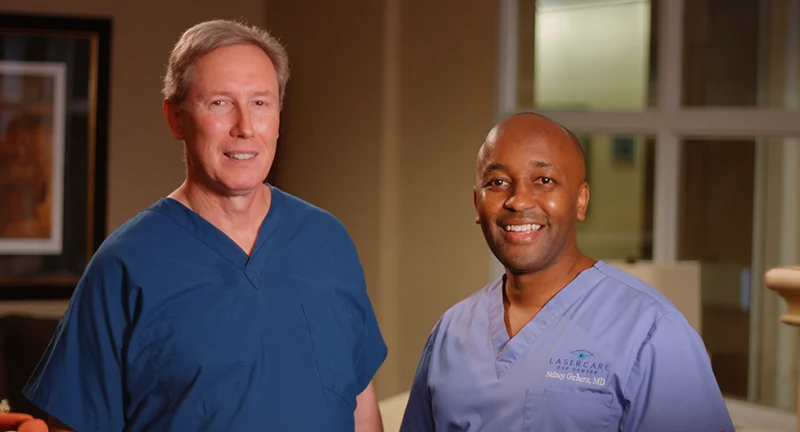
When Cataract Surgery is required in a former LASIK or PRK patient, it is important to ensure you go to a Refractive Cataract surgeon who is experienced in both LASIK and Cataract surgery. Drs. Sidney Gicheru, Kyle Maclean and Sydney Wendt have a lot of experience performing cataract surgery in patients with a prior history of LASIK/PRK. Failure to do this, may result in some nasty surprises.
I’ve had LASIK before; how should I choose my Cataract Surgeon?
Patients who have had prior Laser Vision Correction (LASIK, PRK and SMILE) and need cataract surgery are a unique group of patients. At LaserCare Eye Center, we are unique in that we took over the charts of Bill Boothe MD (the one-time highest volume LASIK surgeon in the World) and have done cataract surgery on many of the several 100,000s of patients he did LASIK on.
Our recommendations are:
- Choose a surgeon who has a lot of experience doing cataract surgery on former LASIK and PRK patients. After LVC, the cornea is either abnormally flat or steep. If the surgeon is inexperienced in post-LVC cataract surgery and they use outdated lens calculation formulas, you are almost guaranteed to have residual myopia or hyperopia, which would require glasses after surgery. At LaserCare Eye Center, we are experienced in doing post-LASIK cataract surgery.
- Ensure your surgeon is using the latest formulas for your lens power selection and Failure to do this increases your risk of having a lot of residual myopia and hyperopia.
- Ensure the surgeon has access to ORA intraoperative aberrometry to double check your lens power in the OR. It does not offer a 100% guarantee but has helped us with our success rate with cataract surgery in post-LASIK patients.
- Ensure the surgeon has a LASIK suite in case you need LASIK or PRK after cataract surgery. This is rare with modern techniques, but a MUST-HAVE.
If you live in Dallas-Fort Worth-Plano and have had LASIK, please call 214-328-0444 for a Cataract evaluation.
Why are the LaserCare Eye Center Surgeons experts at Cataract Surgery in LASIK Patients?
At LaserCare Eye Center, our surgeons, Drs. Sidney Gicheru, Kyle Maclean and Sydney Wendt are experienced in performing cataract surgery on patients with a prior LASIK or PRK. This is a special class of patients that requires extreme attention, expertise and experience.
The average Cataract Surgeon only does a handful of Post-LASIK Cataract surgeries every year. At LaserCare Eye Center, we perform Cataracts surgery on POST-LASIK/PRK patients EVERY WEEK. Most days, Post-LASIK/PRK patients make up 50% of our Cataract surgeries. So, we have a lot of expertise and experience with this.
Why does LaserCare Eye Center have so much experience and expertise with Cataract Surgery in Post-LASIK and PRK patients?
There are 3 reasons:
- We have always believed in the concept for Vision for Life:
- The LASIK only practices do LASIK and then show you the door.
- LaserCare Eye Center is different: Regardless of which of the 6 refractive surgeries we perform, we always ask the patient to keep coming back for annual exams to monitor their progress.
- We have been doing LASIK since 2000 and have tens of thousands of LASIK patients who are approaching Cataract surgery age.

-
When Bill (William) Boothe MD retired in 2015, he formed an alliance with Sidney Gicheru MD and LaserCare Eye Center:
- Dr. Boothe was the one-time highest volume LASIK surgeon in the World (we actually have the plaque from a Laser vendor).
- As such, we have a database of over 150,000 post-LASIK patients.
- Because he trusted us and referred his patients to LaserCare Eye Center, we have performed Cataract Surgery on thousands of his former LASIK/PRK patients.
- Reputation: When you have a good reputation with Cataract Surgery with Post-LASIK patients, word gets around.
- We perform this surgery on local patients and routinely have patients fly from out of town and out of state for our expertise.
- Please see our Google reviews and our Instagram page. We routinely perform Cataract Surgery on Post-LASIK patients.
- We are grateful for the patients who have trusted us for their Cataract Surgery.
Is every former LASIK/PRK patient a great candidate for a multifocal lens at their Cataract surgery?
The answer is no. It really depends on:
- The health and shape of the cornea:
- If the laser ablation is well centered on the visual axis, the treatment was not too extreme and the cornea is regular in shape, these patients often can do well.
- If the laser ablation is decentered (seen mainly with older lasers) or the cornea is not regular, then multifocal lenses should be avoided.
- The early generation lasers used in the late 1990’s and early 2000’s (rarely 2010’s if the surgeon did not upgrade their laser) tended to leave the cornea with an abnormal flat shape that can affect vision (especially night vision). Cataract surgery will not correct these visual aberrations.
- Whether the patient had an enhancement after their original LASIK or PRK surgery:
- In general, LASIK patients can be harder to target than patients with virgin corneas. But with modern lens formulas, ORA Smartvision, experience and expertise, we can get a great result most of the time.
- Patients with prior LASIK/PRK enhancements are much harder to target. Often times, we instead recommend LAL or LAL-Plus for these patients since we have the ability to finetune the prescription for a limited time after surgery. This allows us to get a better result and get it faster.
- Additionally, it is not always advisable to enhance these patients a 2nd or 3rd time after cataract surgery. Remember, every LASIK/PRK treatment creates an interface that can cause light scatter and aberrations that can affect vision.
Ultimately, Cataract surgery patients with a prior history of LASIK or PRK should see a Refractive Cataract Surgeon who has both experience and expertise with both Cataract surgery and Laser Vision correction procedures such as PRK and LASIK.