

Laser Cataract Surgery Dallas
When Dr. Gicheru founded LaserCare Eye Center in 2000, he understood lasers were the future of eye surgery. He picked the name LaserCare Eye Center because lasers are our DNA and exceptional “CARE” is our specialty.
We were one of the first practices in the area to offer laser assisted Cataract Surgery. We have used this since 2014. These lasers are expensive to acquire and to maintain. But we feel they allow us to perform cataract surgery in a much more predictable and accurate way. We are constantly re-investing in technology.
We offer 2 different options for Lasers for Cataract Surgery:
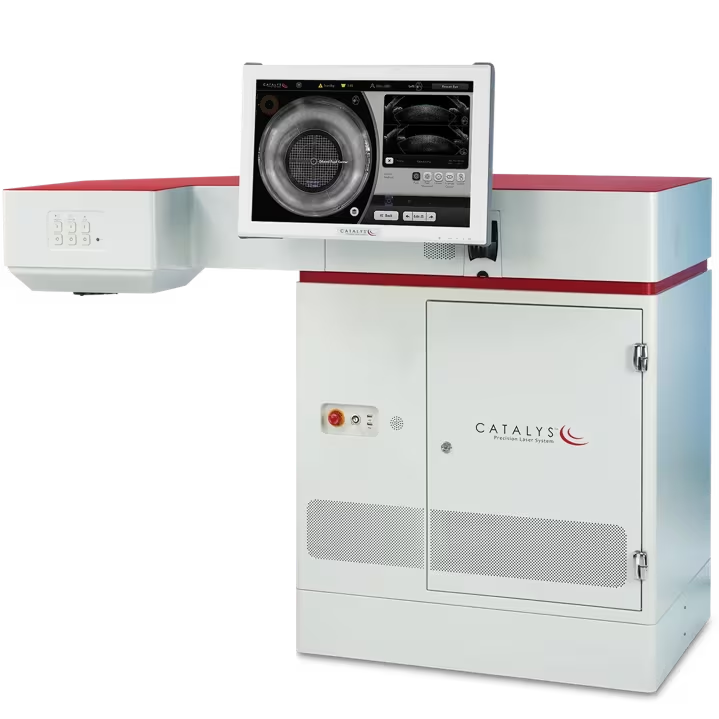
CATALYS™ Precision Laser System
This is the MOMENT
The Catalys Precision laser system by Johnson and Johnson:
- The Catalys femtosecond laser is a system used to assist with cataract surgery.
- It can be used for the following steps of cataract surgery:
- Real time imaging of the eye.
- Creation of corneal incisions to assist with removal of the cataract.
- Creation of corneal relaxing incisions to correction low-medium amounts of astigmatism.
- “Softening” of the cataract to facilitate lower energy use during phacoemulsification (the ultrasound technique used to fragment and remove the cataract from the eye). Lower energy use has been associated with quicker visual recovery.
- Creation of a perfect round capsulotomy, the opening in the capsule of the lens that allows access to the cataract. When done manually, a hand held needle is used and the opening can be irregular (not round) or decentered if the patient moves.

The Zeiss Visumax 800 femtosecond laser:
- Although this laser is FDA approved for SMILE, it is sometimes use it off-label to create LASIK flaps for Cataract Surgery patients to allow us to fine-tune myopia, hyperopia and astigmatism after cataract surgery.
- The laser was FDA approved in 2024.
- At the time of this writing, it is the fastest LASIK flap maker and can make a flap (off-label) in as little as 5 seconds.
What are the advantages of Laser Cataract surgery over Standard Cataract surgery?
The advantages are numerous:
- Precise and customizable laser incisions instead of handmade blade incisions. The latter have less control and can be irregular if the patient moves or the surgeon has a tremor.
- Great visualization of the operating field using high definition (HD) Ocular OCT.
- Procedure automation.
- Use of the laser to “soften” the lens to allow easy Cataract removal. Typically, less ultrasound power is used with laser cataract surgery, which can result in quicker visual recovery.
What at the disadvantages?
- The lasers are expensive to buy, use and maintain. At LaserCare Eye Center, we are technology forward and feel the advantages make it worth it.
- Laser Cataract surgery is not covered by insurance and there is a patient out of pocket cost for its use.
- Not all patients make perfect candidates for the procedure.
Why do some surgeons insist on doing Cataract surgery the old fashioned way?
- The lasers are expensive to buy, use and maintain.
- They may not see the value in it for their patient population.
- Some surgeons are Refractive Cataract surgeons and others are not:
- The surgeons at LaserCare Eye Center are Refractive surgeons first and Cataract Surgeons second. This means, provided the patient is willing to have Refractive Cataract surgery, our goal is to reduce their dependence on glasses after surgery.
- Some surgeons only do basic cataract surgery, which means simple removal of the cataract, with the expectation the patient will receive glasses at the end of the process.
- As with any field, not everyone keeps up with technology.