

Cataract FAQ Dallas
What is a Cataract?
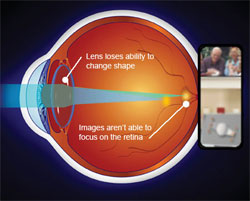 A cataract is a clouding of the natural lens inside your eye. This lens, located behind the iris (or colored part of your eye), works just like the lens of a camera. It focuses light images on the retina, which sends the images to your brain.
The human lens can become so clouded that it keeps light and images from reaching the retina. Eye injury, eye inflammation, certain diseases, or even some medications (such as steroids) can cause the clouding. But, in over 90% of cases, clouding is caused by the aging process.
What Symptoms do Cataracts Cause?
A cataract can be the reason sharp images become blurred, bright colors become dull, or seeing at night is more difficult. It may also be why the reading glasses or bifocals that used to help you read, or do other simple tasks, no longer seem to help.
Other symptoms to look for include:
- Clouded, blurred or dim vision
- Increasing difficulty with vision at night
- Sensitivity to light and glare
- Seeing halos or starburst around lights
- Frequent changes in Eyeglass or Contact lens prescription
- Fading or yellowing of colors
- Double vision in a single eye
How are Cataracts treated?
At LaserCare Eye Center, Drs. Gicheru, Maclean and Wendt are committed to providing the safest and the highest technology cataract surgery you desire. Patients should spend time educating themselves about the best option for them. You and your surgeon will make the final decisions collaboratively.
Here are the decisions you will need to make:
DECISION #1: Refractive Cataract Surgery vs Standard Cataract Surgery.
- Refractive Cataract surgery is performed using advanced technology to help reduce your dependence on glasses after cataract surgery. This includes laser assisted cataract surgery and the use of advanced technology lens implants (more below). If you are choosing Refractive Cataract surgery, there are other decisions to make below.
- Standard Cataract surgery is the type of surgery that is covered by insurance. In the majority of cases, the end result is glasses (bifocals, trifocals) are required to fine-tune vision. This type of surgery never includes the use of a laser, but rather the use of surgical knives. It only includes the use of a monofocal lens that can only be aimed at one distance. If you are choosing Standard Cataract Surgery, there are no further decisions to make.
DECISION #2: Laser assisted surgery vs Non-laser surgery.
- Laser offers more predictability and accuracy.
- We have performed Laser assisted Cataract Surgery since 2014 and have our own laser.
- Currently, we use a Johnson and Johnson Catalys laser for Laser assisted Cataract Surgery cases. As a Technology-forward Ophthalmology practice, our technology offerings change all the time and so always call 214-328-0444 to find out what we are currently offering.
- The use of the laser for cataract surgery is never covered by insurance and our staff will be happy to discuss our pricing packages.
DECISION #3: Type of Advanced technology lens.
- Dr. Gicheru served on the FDA’s Dermatologic and Ophthalmic Device committee for 5 years so we always assessing the most recent FDA approved lens technology. We also use our experience with the lenses to select our offerings.
- LaserCare Eye Center currently offers 4 types of Advanced Technology Lenses classes, in addition to standard monofocal lenses:
- Advanced Technology Lenses:
- Multifocal Lenses:
- These lenses are capable of correcting vision for the 3 Cardinal Zones of Vision:
- Far vision: Driving.
- Intermediate vision: Computer and cell phone use.
- Near vision: Reading a book.
- They offer the greatest freedom from glasses.
- LaserCare Eye Center has a lot of experience with multifocal lenses because it is the most frequent lens implant class we use.
- These lenses are capable of correcting vision for the 3 Cardinal Zones of Vision:
- Light Adjustable Lenses: This is special lens that can be implanted and then adjusted to correct residual myopia, hyperopia and astigmatism. Given they are essentially monofocal lenses, the only way to get good far and near vision is to target them for monovision (one eye far distance and the other for near).
- TORIC lenses: This lens implant class can used to correct moderate to high amounts of astigmatism. They come in Multifocal, EDOF and monofocal versions.
- Extended depth of Focus Lenses: This lens implant class can be corrected for far distance with intermediate vision possible. Unless paired with mini-monovision, requires the use of reading glasses for fine/small print.
- Multifocal Lenses:
- Standard Monofocal Lenses: These are the types of lens implants that insurance companies cover. They require the use of glasses after surgery. Can be paired with the use of the laser to reduce the need for glasses in the far distance.
Please click here for more information about the lens implant classes we offer:
DECSION #4: Decide when to scheduled your surgery!!
- Our staff will be happy to help you with this.
- Please call 214-328-0444 with any questions. As a Technology-forward Ophthalmology practice, our technology offerings change all the time and so always call 214-328-0444 to find out what we are currently offering.